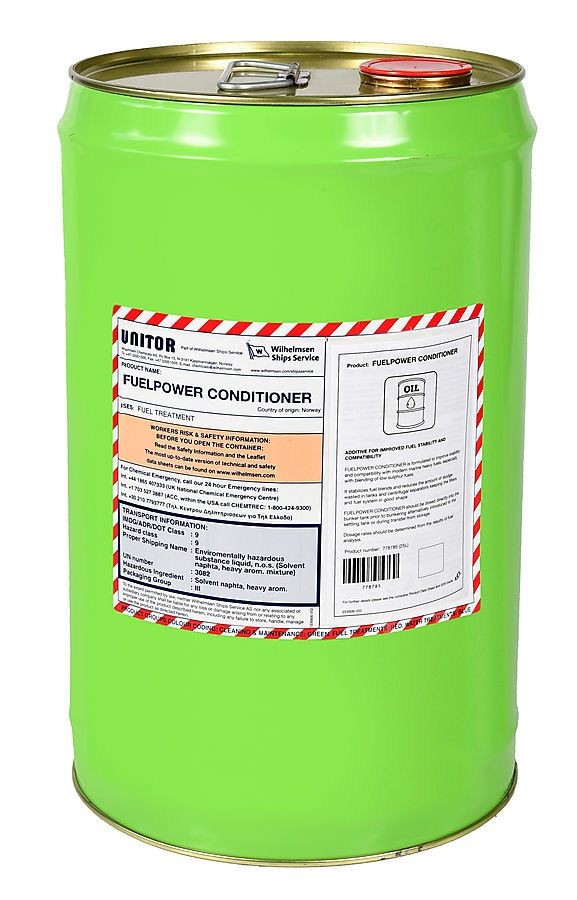
As modern marine fuels become more complex particularly with the blending of low-sulphur and Bio-blended fuels, fuel stability and compatibility between different types of fuel are growing concerns. Unitor™ FuelPower Conditioner addresses these issues by stabilising fuels and reducing asphaltene sludge formation in the fuel oil system. It simplifies the onboard management of residual blends, including Bio-HSFO and Bio-VLSFO.
In addition, Unitor™ FuelPower Conditioner enhances purifier separation, prevents agglomeration, and keeps fuel homogeneous, delivering a stable fuel ready for combustion.
Features
Compatibility & Stability: Reduce residual fuel type (HFO/Bio-HFO, VLSFO/Bio-VLSFO) related compatibility & stability challenge onboard
Sludge Prevention: Disperse and stabilize asphaltene sludge in residual fuel
Agglomeration Prevention: Prevents further agglomeration of asphaltene in unstable fuels, reducing purifier sludging and filter choking
Benefits
Improved Operational Efficiency: Minimise operational risk of purifier sludging and filter choking, reducing unplanned equipment downtime
Enhanced Fuel Stability: Stabilize residual fuel (including Biofuel) in fuel tank, leading to clean fuel tank and less fuel tank cleaning prior to dry docking & fuel changing
Facilitating Combustion: Facilitate combustion process by homogenising asphaltene sludge, resulting in better combustion efficiency
Reliable fuel specialty treatment chemicals, with performance verified by major third-party independent labs and technical support that is unmatched in the maritime industry.
Directions for use
Dosage and Control
Ideally, FuelPower Conditioner should be dosed directly into the bunker tank prior to bunkering. However, it can be introduced to the settling tank or during transfer from storage. Dosage rates are best determined from the results of fuel analysis, i.e. sediment content or compatibility test which is easily performed on board using the Compatibility Test Kit.
| ASTM SPOT |
1 |
2 |
3 |
4 |
5 |
| DOSE RATE |
**1:25 000 |
1:15 000 |
1:10000 |
1:5000 |
*1:2500 |
| TSP level
|
Dosage (ppm) |
Comment |
| 0,01–0,03 |
1:25 000 (40 ppm) |
Due to the indication of poor reserve stability of some VLSFO, we advise a low protective dosage. |
| 0,03–0,06 |
1:20 000 (50 ppm) |
When the TSP increases the reserve stability of the fuel will also be poorer, so we advise a low protective dosage. |
| 0,06–0,1 |
1:15 000 (67 ppm) |
Once the TSP approaches the max specification sludging will most likely occur. Reserve Stability will also be poor, so a higher dosage is recommended. |
| 0,1–0,2 |
1:10 000 (100 ppm) |
With a TSP out of specification it is important to have a good impact on the sludging with a higher dosage. |
| 0,2–0,5 |
1:5 000 (200 ppm) |
A far-off spec TSP fuel is never a good idea to use but when it occurs it is important to be able to reduce sludging and operational impact as much as possible. |
| *0,5+ |
1:1 000 (1000 ppm) |
We would not recommend using any of these fuels but if there is no choice a high dosage needs to be used to have a chance to reduce the sludging from these fuels |
* Avoid using this fuel if possible.
** Fully compatible blends, with a sediment percentage of less than 0.05, should not require treatment for incompatibility. Marginal number 1 spots may cause sludging if the fuel is not handled carefully, so some treatment may be necessary, especially if other problems such as water content or corrosion are apparent.
Fuel tank cleaning
The average dosage for FuelPower Conditioner is 1:15 000 or 67 ppm. When starting a dosage into a fuel tank it is advisable to use a staged dosage to avoid high amounts of sludge from the fuel into purifiers and filters. This is especially important if the fuel tank has not been cleaned for an extended period of time. With a stage dosing smaller amounts of sludge will be picked up and over a longer period of time.
| DOSING |
DOSAGE LEVEL |
COMMENT |
| 1st Time |
1:25 000 |
Initial dosage not to upset the tank |
| 2nd Time |
1:20 000 |
Second and third dosages can be done a bit higher as most of the easily available sludge will be gone |
| 3rd time and forward |
1:15 000 |
From the 3rd dosage and forward the recommended dosage of 1:15 000 can be used |